
Your Hair Loss Might Not Be Genetic. It Might Be Your Follicles Shrinking.
Your Hair Loss Might Not Be Genetic. It Might Be Your Follicles Shrinking.
Someone in your family probably has thinning hair too, so you've made peace with it. "It's genetic, there's nothing to do about it." That's the line most people repeat to themselves. It's also only half true.
Genetics does play a role for some people. But a lot of what actually causes visible thinning is a gradual process called follicle miniaturisation, and unlike a fixed genetic sentence, this process has a timeline you can influence.
What Miniaturisation Actually Means
Each hair follicle has a natural growth cycle. Over years, certain triggers, hormonal, environmental, or inflammatory, can cause the follicle to shrink slightly with every cycle. A shrinking follicle produces thinner, shorter, weaker hair each time, until eventually it stops producing visible hair altogether.
- It's gradual. You won't notice it happening week to week, only in hindsight over a year or two
- It often starts at the crown or hairline before spreading, which is why those areas thin first
- Hormonal sensitivity plays a role, but so do inflammation, poor scalp circulation, and chronic stress
- The follicle itself often survives even as it shrinks, which is exactly why intervention can still help
That last point matters most. A shrinking follicle is not automatically a dead one. That distinction is the entire reason early action makes such a difference.
The Ayurvedic Perspective: Weakened Root Nourishment
Ayurveda has always framed hair health around the strength of the root, not just the visible strand. A weakening follicle reflects poor Rasa Dhatu, the nutritive tissue layer responsible for nourishing hair at its source. When Rasa Dhatu is depleted, whether from poor diet, chronic stress, or years of scalp neglect, the root simply doesn't get what it needs to keep producing strong, full strands.
This is why Ayurvedic hair treatments have always focused as much on internal nourishment, diet, herbs like Bhringraj and Amla, sleep, as on topical oiling. Treating the strand without feeding the root was never considered a complete approach.
What You Can Do Before It Progresses Further
The earlier you catch this, the more responsive the follicle tends to be. Waiting years rarely helps.
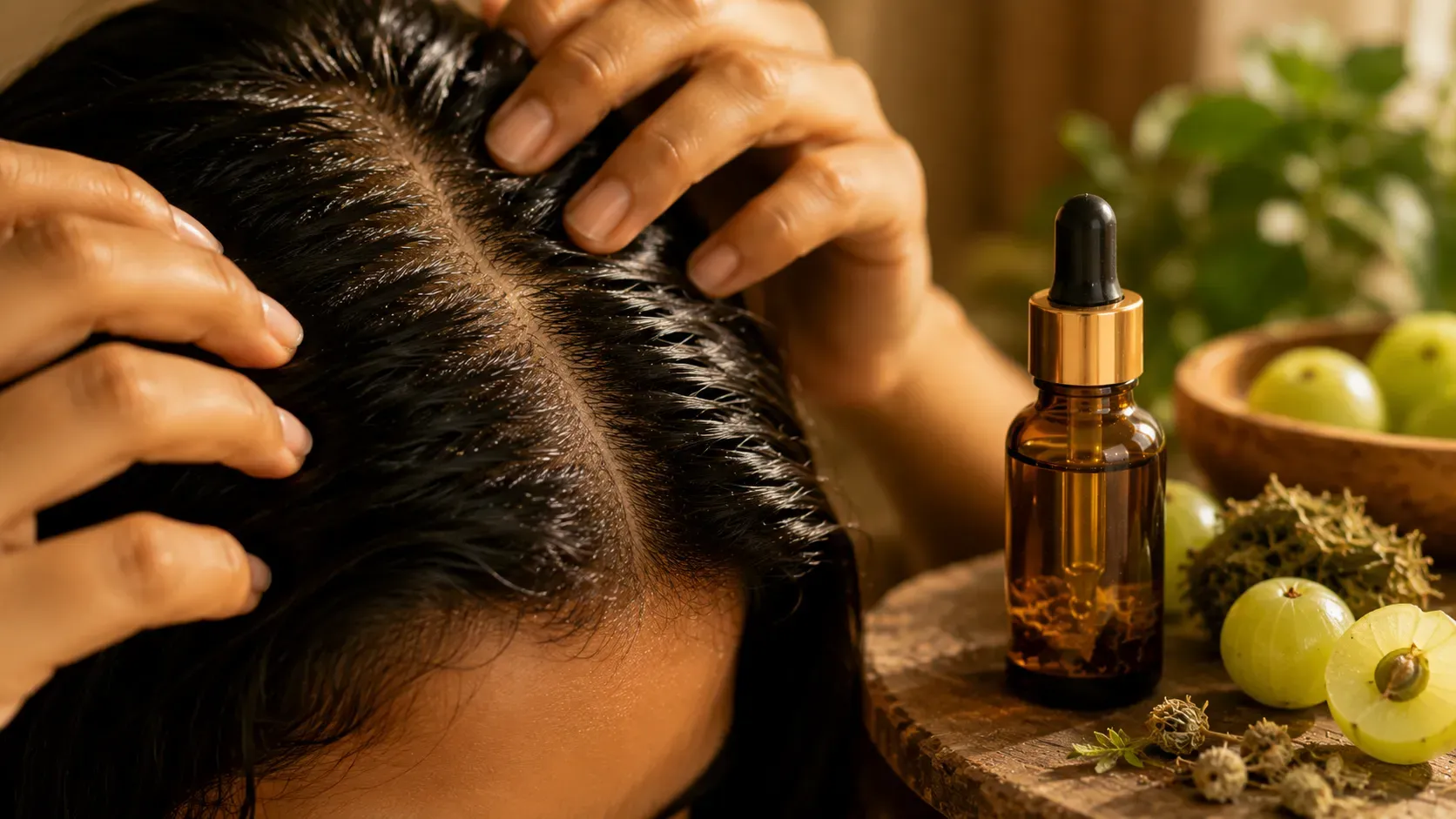
- Improve scalp circulation daily. A few minutes of scalp massage increases blood flow to the follicle, which directly supports its ability to keep producing thicker hair over each cycle.
- Address inflammation at the scalp level. Chronic dandruff, irritation, or excess oil all contribute to a hostile environment for follicles. Calming the scalp is not a cosmetic step, it's a structural one.
- Support Rasa Dhatu through diet. Iron, protein, and healthy fats matter here more than most people realise. A depleted diet shows up at the root before it shows up anywhere else.
None of this "cures" genetic predisposition entirely. But it can meaningfully slow the miniaturisation process, and in many cases, visibly improve density where the follicle hasn't fully shut down yet.
Don't Wait for the Mirror to Convince You
By the time thinning is obvious in the mirror, the miniaturisation process has usually been running for a while already. If you've noticed your hairline moving, or your crown looking a little more scalp than hair lately, that's the window to act, not to wait and see.
Our Hair Care range is built to support exactly this stage, strengthening circulation and calming scalp inflammation to give shrinking follicles the best possible environment to recover in.
"Genetic" doesn't have to mean "nothing to do." It usually just means "start earlier than you think you need to."
Top Posts


Popular Terms
Leave a Response
Your email address will not be published. Required fields are marked *